Showing posts with label Daihatsu. Show all posts

Subaru Justy: Rebadged Daihatsu Sirion/Perodua Myvi gets racy upgrades!

Subaru has revealed a newly improved Justy 1.0R which is basically a re-badged version of the Daihatsu Sirion

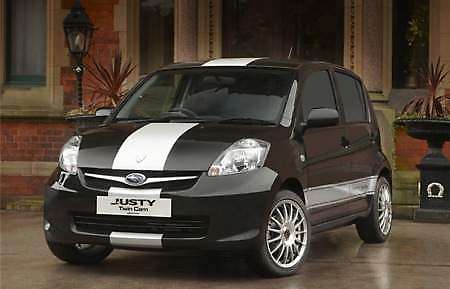
This newly “improved” version, designated as the Justy 1.0 Twin Cam Special Edition carries a limited production run of 100 units only, with 50 finished in Black Mica and another 50 in Shinning Red.

With a base price of £9,995 which is about £700 more than the standard 1.0R, the Twin Cam Special Edition is powered by the same 68HP 3 cylinder engine found in the 1.0R, and is treated to a rear roof spoiler, twin exhaust system, over roof ‘viper stripes’ and side decals, leather and alloy gear knob and rear privacy glass.

As standard, just like the 1.0R model, it features ABS with EBD, radio/CD player with AUX input, four electric windows and remote central-locking. There are also driver, passenger, front side and curtain airbags. Potential buyers can also opt for 15-inch Monza R alloy wheels wrapped with Toyo 185/55R15 tires for an extra £ 600.

Just the Myvi we have back at home, it is also one of the cheapest vehicles to run in Europe with a 64.2 miles to the gallon fuel consumption figure based on the Extra Urban Cycle and an annual £ 35 Road Fund License fee. Subaru also further revealed that “The new Justy 1.0 Twin Cam now offers even more, and offers a racy alternative for the younger, and the young-at-heart, motorist”.
Daihatsu Luxio MPV launched in Indonesia

Daihatsu Luxio

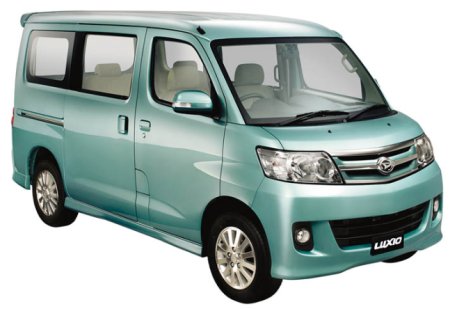
Daihatsu Motor Co Ltd has launched the new Daihatsu Luxio in Indonesia. While the Toyota Passo Sette/Daihatsu Boon Luminas could be considered a baby Wish of sorts, the Luxio is a baby Alphard, and unlike the Passo Sette offers dual sliding rear doors. This vehicle used to go by the “Daihatu Stylo” codename while still under development, but later the Luxio name was picked and finalised.

Under the hood is the often-used 3SZ-VE 1.5 liter DOHC VVT-i cast-iron block engine producing 109 PS at 6,000rpm and 141Nm of torque at 4,400rpm, available with either a 5-speed manual or a 4-speed automatic. While offering similiar power outputs to the 1NZ-FE in the Vios, does not have the NZ-series engine’s aluminium block. The Luxio uses a MacPherson strut suspension at the front and a 5-link rigid axle at the rear. The body is said to be built on a monocoque chassis. It is 4,165mm long, 1,665mm wide, 1,915mm tall, has 180mm ground clearance and a turning circle of 5.2 meters.

Astra Daihatsu Motor targets sales of 1,000 units a month at a price tag of between 136 to 165 million rupiah, which is approximately between RM42k to RM51k for 4 spec levels ranging from the D, M, X, and X automatic.

Daihatsu wants you to have a nice warm cup of…

Daihatsu Mira Cocoa

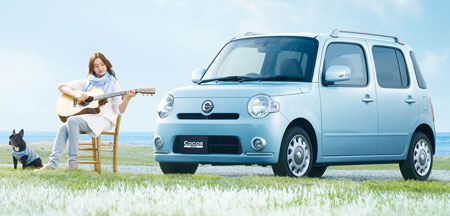
Daihatsu has launched yet another body variation of the Mira in Japan, this time called the Mira Cocoa.

In Daihatsu’s own words, the use of the name Cocoa was chosen because the car intends to give the driver and passengers that comfortable and relaxed feeling of drinking a hot cup of cocoa on a cold day.

The Mira Cocoa measures 1,530mm in height, 1,930mm long and 1,345mm wide. Only one engine option is available in Japan – the 660cc KF-VE with DVVT variable valve timing, producing 58 PS at 7,200rpm and 65Nm of torque at 4,000rpm. There are two different transmissions available – a 4-speed auto or a CVT transmission, with the latter being more fuel efficient.

For the 2WD car, the CVT can provide up to 23.5 km per liter on the Japan 10-15 test cycle while the 4-speeder can only do 19.4km per liter. 4WD versions can do 20km and 18.6km per liter respectively for the CVT and 4-speed cars.

Daihatsu is shouting about the funky new rear view mirror that they’re using in the Mira Cocoa, claiming its the first of its kind installed in a vehicle in Japan. It integrates a back view monitor into the rear view mirror, which is also equipped with an auto anti-glare function. Now I wonder why there’s no mention of aerodynamics values…

Tokyo 2009: Daihatsu e:S compact car

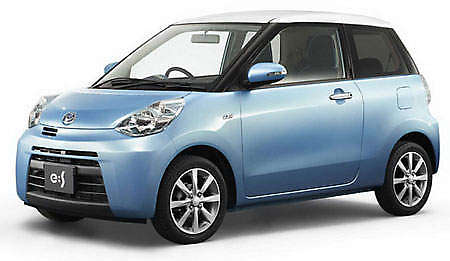
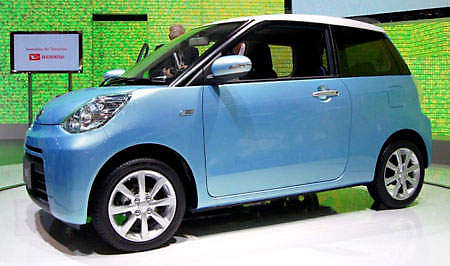
This is the new Daihatsu e:S. It weighs just 700kg and is powered by a 660cc engine, typical of K-cars in Japan. The car looks like it’s in the same class as the Ford Ka and it uses a current Daihatsu production platform but with its wheelbase shortened to 2,175mm. That’s even shorter than the Viva’s 2,390mm. The light weight and the fuel efficient engine with features such as Idling Stop System results in an estimated fuel efficiency of 30km per liter under the Japan 10-15 test! In case you were wondering what the name meant – e:S stands for ‘eco and smart’.

Daihatsu e:S Concept

More Daihatsu K-Car Concepts for Tokyo 2009

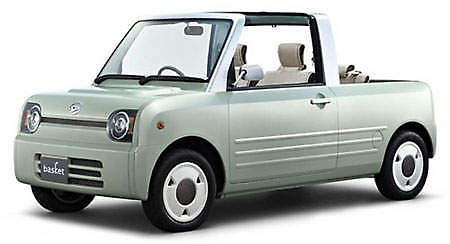
daihatsu-basket-450

Want a cheap “landaulet”? Get a Daihatsu Basket Concept when it goes into production. Right now it’s just a concept little lifestyle “K-truck” with a removable soft top over the rear seats. There’s even a little boot deck behind the rear seats for tools and stuff in case the Basket is used to carry stuff, like another tool commonly used by people with the same name, the common basket.

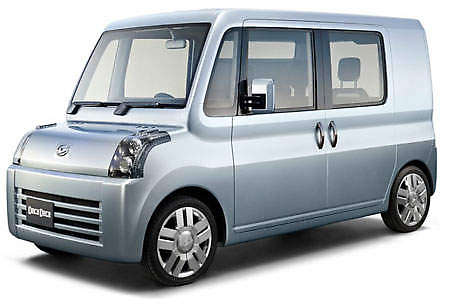
tokyo-daihatsu-decadeca

And then we also have this fridge on wheels that’s called the Daihatsu DecaDeca. There is no B-pillar and both the front and rear doors swing outwards towards the front and rear of the van respectively. And like most K-vehicles in Japan, it is powered by a 660cc engine. And it’s nice that both the DecaDeca and the Basket do have a certain family resemblance about them.

Advertisement 2nd generation Daihatsu Boon gallery February 15, 2010 at 5:01 pm By Paul Tan Filed Under Cars, Daihatsu, International News Here’s so

Looking at photos are one thing but seeing a concept car in real life is another. The e:S has some really small rear seats though making it somewhat like a 2+2, but you’re better off using that space as a boot instead.

To give you an idea, the e:S Concept’s 2,175mm wheelbase is actually even shorter than the now-”extinct” Kancil’s 2,280mm wheelbase. It’s based on an existing platform but had its wheelbase shortened so it should mean the development cost for a production car would not be excessively high.

Weight loss techniques such as slim and lightweight seats and light materials give the e:S a total weight of 700 kg. As a result, its 660cc engine with auto-start stop can take it as far as 30km on a liter of fuel under the Japan 10-15 drive mode.

Daihatsu  e:S Concept

2nd generation Daihatsu Boon gallery

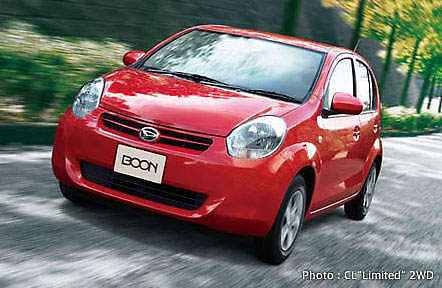
Here’s some shots of the Daihatsu version of the new 2nd generation Toyota Passo. If you want to know more about what’s changed with the 2nd generation car. The platform is most likely similiar to the 1st generation but there are new Dual VVT-i engines. Look after the jump for the gallery of the Daihatsu-badged car. Perodua’s version will come soon I suppose!